How to Choose a Display Pedestal for Fragile or Valuable Objects
A display pedestal for a fragile or valuable object needs three things right: a load rating that actually covers the piece, a top sized to the object's footprint rather than the room, and a base that keeps the load centred. Get those three right and the pedestal disappears into the background, which is the point.
In this article
- What actually matters when the object can't be replaced
- How much weight can a display pedestal hold
- What top size do you actually need
- Does height change the calculation
- Matte white or matte black
- Custom sizes for oddly shaped or oversized pieces
- FAQ
What actually matters when the object can't be replaced?
Most display pedestal shopping starts with style, then price, then a size that looks about right. For a fragile or valuable piece, that order should flip. Start with the object: its weight, its footprint, whether the weight sits centred or off to one side. Then work backward to a pedestal that can carry it without you having to think about it again.
A pedestal that looks correct but is undersized for the load is a slow-motion problem. It won't fail the first week. It sags, or the finish stresses at the joints, months in, usually right before an opening or a photo shoot.
How much weight can a display pedestal hold?
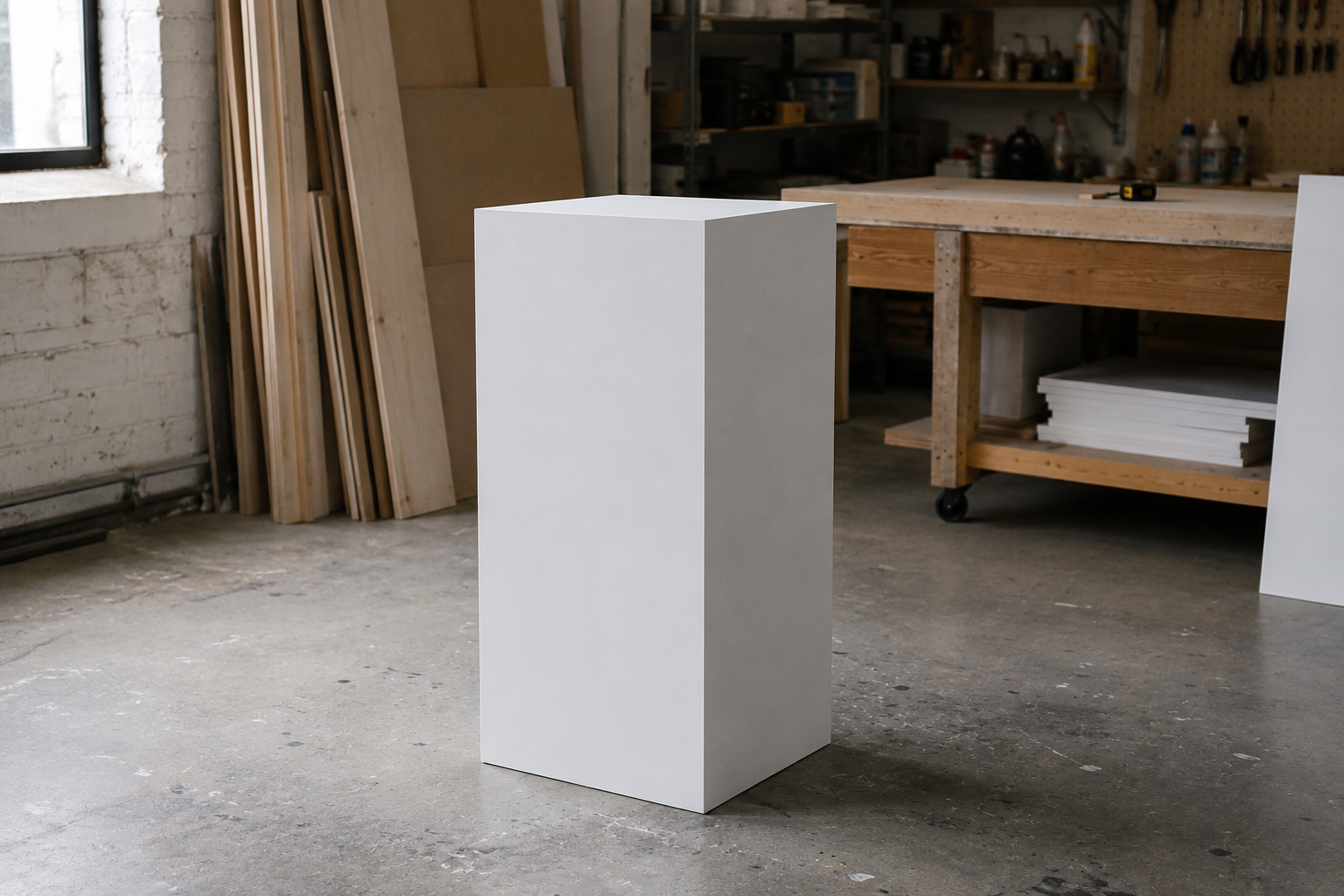
This depends entirely on construction. A well-built MDF-core pedestal with a seamless cabinet-grade finish, like the ones we build, carries a centred load of up to 200 lb on a 16 inch top. Capacity scales with top size, so a larger top rated for the same construction generally holds more, and a narrower top holds less.
The word "centred" is doing real work in that sentence. Load capacity assumes the weight sits in the middle of the top. An object pushed to one edge, or a base that overhangs the top, changes the math even if the total weight is well under the rating.
| Top size | Best suited to |
|---|---|
| 12" to 15" | Small ceramics, single sculptural objects, jewellery displays |
| 16" to 18" | Mid-size art objects, crystal or glass pieces, urns |
| 20" to 24" | Larger sculpture, multi-object arrangements, retail hero fixtures |
| 30" and up | Oversized pieces, event and activation staging |
What top size do you actually need?
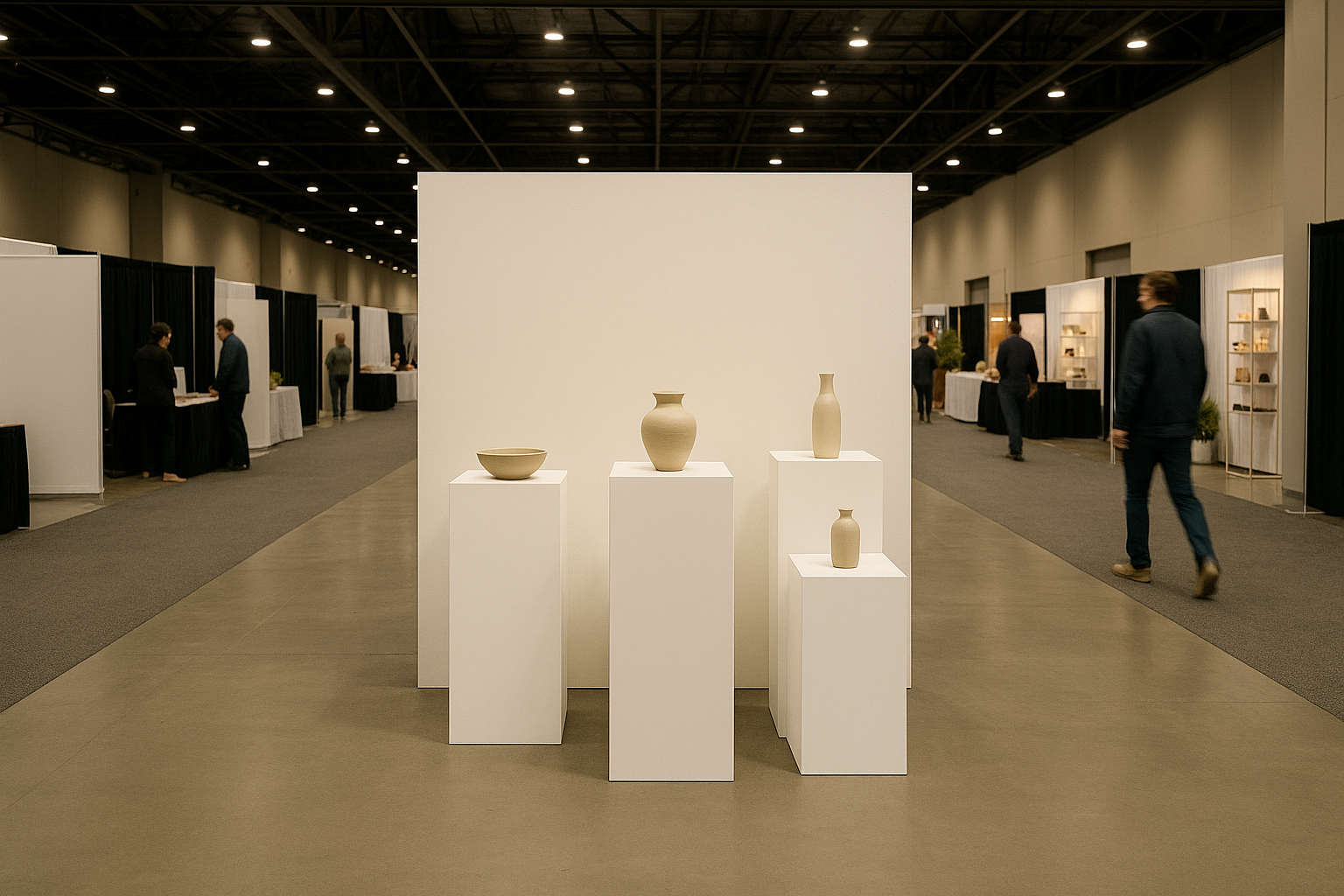
Measure the object's base, not its widest point. A vase that flares out at the shoulder but has a six inch footprint still only needs a top sized to that six inches, plus enough margin that the piece reads as centred rather than perched. As a rough rule, leave two to four inches of clearance around the base on each side. Any less and the object looks like it's about to walk off the edge. Any more and the pedestal starts competing with the object for attention, which is the opposite of what a pedestal is for.

More than 90 top and height combinations, in matte white or matte black, rated to 200 lb centred load on the 16" top.
Does height change the calculation?
Height changes visibility and sightlines more than it changes load capacity, but it isn't unrelated. A taller pedestal with the same top size has a higher centre of gravity once the object is placed, which makes level ground and a stable base more important, not less. If the pedestal will sit somewhere with foot traffic close by, a wider top at a given height buys you margin against accidental contact.
For eye-level viewing in a retail or gallery setting, 32 to 36 inches is a common range. For tabletop or vitrine-adjacent display, 12 to 18 inches keeps the object within easy reach for staff who need to rotate or clean it.
Matte white or matte black: does finish matter here?
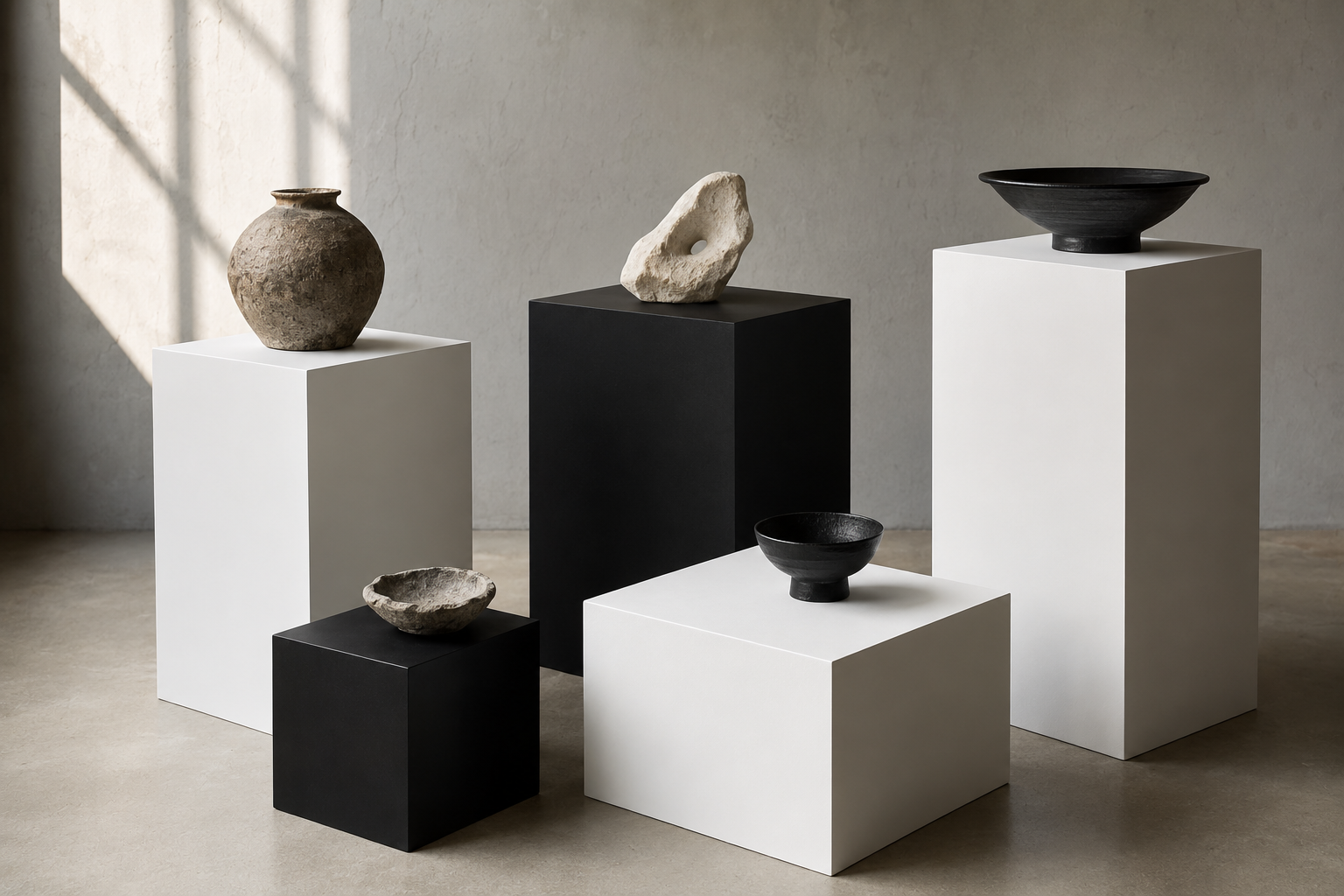
Functionally, no. Both finishes are the same cabinet-grade coating on the same MDF core, so load capacity and durability don't change with colour. The choice comes down to what makes the object read clearly. Pale ceramics and light stone tend to hold their detail better against black. Dark bronze, dark wood, and anything with strong shadow lines often reads more cleanly against white. If you're not sure, photograph the object against both in your own lighting before committing to fifteen units.
Custom sizes for oddly shaped or oversized pieces
Standard sizing covers most objects, but not all of them. A wide, shallow sculpture or an unusually tall, narrow piece can fall outside the standard top and height matrix. Custom colours and non-standard dimensions are handled as quotes rather than fixed pricing, since the cost depends on the specifics. Email hello@plinthsupply.com with the object's dimensions and weight and we'll size a pedestal to match.
Frequently asked questions
Can a display pedestal hold ceramics or glass safely?
Yes, provided the pedestal's load rating comfortably exceeds the object's weight and the weight sits centred on the top. Ceramics and glass are usually well within a standard pedestal's capacity; the bigger risk is edge placement, not total weight.
What's the difference between load capacity and weight limit?
They're often used interchangeably, but load capacity usually assumes a centred, static load, while a stated weight limit sometimes ignores placement. When in doubt, treat the number as a centred-load figure and keep heavy objects away from the edges.
Do taller pedestals need a bigger top?
Not strictly for load capacity, but for stability, yes. A taller pedestal with a narrow top and a heavy object has a higher centre of gravity, so a slightly wider top is worth considering once you're above 30 inches.
Can I get a custom color to match my object or space?
Yes. Standard finishes are matte white and matte black; custom colours are available on request and quoted individually.
How long does a made-to-order pedestal take?
Standard lead time is 10 business days from our Toronto workshop. Fixed install dates should be flagged before ordering so we can confirm timing, and rush production may be available for an additional fee.
Build a pedestal to fit the object, not the other way around
More than 90 top and height combinations, matte white or matte black, made to order in Toronto.
Shop Display Plinths →Ships within 10 business days across Canada and the US.